

Featured Underwriter: The Players’ Ring
By Gabrielle R. Lamontagne
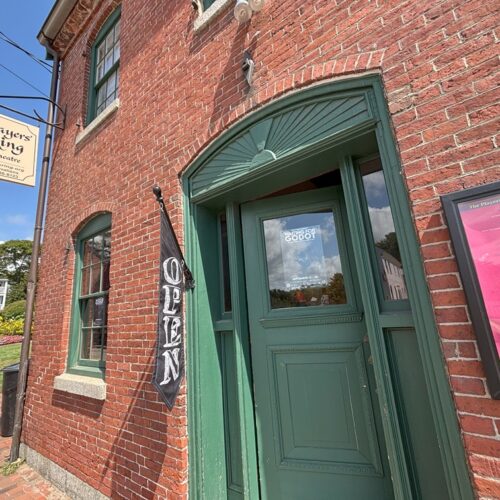
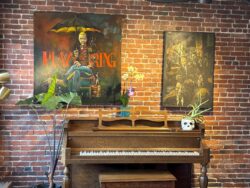
Stepping into the Players’ Ring Theatre, affectionately known to Seacoast locals as “The Ring”, warmth and connection embrace you. Even in the lobby, the warm tones of green and blue make you feel comfortable, while the velvety red theater seats prepare you to stay alert for a brilliant performance. This black box, non-profit theater was established by Gary and Barbara Newton in 1992.
Margherita Giacobbi, Executive Director, embodies this spirit of luxurious style mingled with cozy inclusivity. While the legendary Co-Founder of The Ring, Barbara Newton remains involved with everything going on in the Seacoast Arts scene, Margherita breathes innovation into the way The Ring operates.
There are a few changes that have been put in place in the last several years, such as shifting away from a Revenue-Split model of production, where the people who wanted to put the play on at The Ring would pitch and then also pay for the staging of the play and do most of the marketing.
According to Giacobbi, “One of the big changes was when we decided to become the producer. Now we take all the financial risk of everything. So you still pitch, we still say yes, you are the spearheading force behind this artistic endeavor – but we pay for everything and we pay everybody.” However, she says the pay isn’t enough to quit your day job. “You know, but I am proud of it. It’s still just a gesture. It’s still just a nominal thing. [Yet] it has contributed to shifting a mindset in terms of expectations of mutual commitment to equality, to a standard, to a process. Passion is still paramount.”
The reasons to shift the mindset, she explains, are due to a desire for high quality productions. “We cannot stand to present as Main Stage something that’s not excellent or that strives for excellence.” The Players’ Ring being the producer of the show has a big part to play in that effort. Giacobbi said, “That’s huge because in the past, how could I ask a producer to be bold and ambitious in their choices when they had to pay out of their pocket. Right? So now I can say ‘No, sorry, I don’t want the black floor, two chairs and the table’ unless it’s a vision and it’s intentional.”
Community theatre tends to focus on collaboration and creative exploration rather than quality productions, which is why Giacobbi prefers to refer to The Players’ Ring as a public theater, in reference to its non-profit nature. Coming from a European background culturally and a non-profit background work-wise, Margherita Giacobbi has a lot of thoughts about what it means to run a small, non-profit theater.
“I think I come from a perspective that what art and cultural organizations offer should not think about profit,” she said. “You know, it’s supposed to be a form of entertainment. But I think that sometimes it’s associated with something more elite, something that has a kind of a barrier. That you have to have some sort of intellectual depth or knowledge to truly appreciate it.”
According to Giacobbi, not having to worry about turning a profit leaves room for more heart-centered considerations.
“At the top is: what are we here for? What do you want to put out into the world? How do we want to affect human beings that are both on stage and on the red chairs? And secondary is, how can we do this in the most efficient and accountable way possible, resource-wise?”
Despite the changes, there are important aspects of The Players’ Ring’s culture and community-building that Executive Director Giacobbi would like to preserve.
“I have pretty clear ideas on what makes us very unique. You can have a chance as a playwright to present your new work. We used to premiere work that still needed work.” She explained how this could be a liability for attracting recurring patrons, especially now that the organization has taken control of producing shows. “So now, the new work needs to be polished.”
However, she did mention that if you’re not sure, you can always submit your work for the Main Stage and if the Ring team finds that your work has potential, they may call you up about one of the few slots for their new Writing Lab.
The changes she is involved in at this delightfully petite venue are meant to evoke critical thought from the audience and passion from those involved with crafting the performance, including the crew.
“The second thing that makes us different is that we hire new artists, a new batch of artists and creatives for each show. There’s other people that hire and contract professionally, artists, but there’s more a concept of your repertory company, right? Their model is that they build a new house group of people, maybe they hire different people, but I don’t know how many different individuals they engage in a season, but I doubt that they are 350 people. So, for me that’s very important because [as an artist] your self realization as a human being depends on being able to do what you’re born to do.”
Having met so many artists, designers and other theater lovers, Margherita has a strong sense of the importance of paying creatives for their work.
“I keep meeting in this place people that will become shadows of themselves, if they can’t do that. So, although we’re not talking about thousands and thousands of people, I am very aware that we play a very important role in their lives and in their joy, in their fulfillment as human beings.”
This plays into how The Players’ Ring, and theatre in general, plays a role in leadership of any community. Community leadership has been a prevalent topic throughout the nation this year, so knowing how the arts play a role on a local level is salient.
Executive Director Margherita Giacobbi thinks that part of the role theatre and the Fine Arts play in modern society is to keep us connected to other people. While we have access to instant communication, it doesn’t always lead to authentic communication. We also tend to consume more media in isolation.
She said, “It’s all content that we are happy, in fact, invited most of the time, to consume alone. With our head down. So I think that live performing arts, live theater, live music, even the act of going physically into a gallery counters all of that. You step out of your individuality. You sit shoulder to shoulder with someone else that you might know or not. In this specific case [The Players’ Ring], you are literally also almost able, if you stretch your leg, to trip an actor.”
More than that, she also explained that we are taught by live performance how to listen and receive fully.
“You’re asked to stay put for 90 minutes. There’s no multitasking. You’re asked to just receive. You receive as an individual and as a collective. You are asked to listen. And I think that because you know that this is fiction there’s an element where you’re a little bit more open to accept the points of view of the different characters.”
Of course there’s the dichotomy of how theater and the arts perform leadership and how The Players’ Ring itself plays a specific leadership role in the Portsmouth and greater Seacoast New Hampshire communities.
One of the ways The Ring tries to play a role in leading the community is by presenting diverse perspectives that can sometimes challenge theatergoers’ understanding of events and circumstances around them – such as a play called Granite State Proud by local playwright Bretton Reis.
Margherita said the idea of this was that, “You, maybe for one second, consider what has brought this group of people for individual reasons to join this group.” Even if it’s a group you would usually feel anger towards, the idea, she said, was to evoke “…uncompromised empathy. Basically, if you claim you’re capable of empathy, you’re not just empathetic with people that have your same [perspective].” The same local Players’ Ring alum is also directing Waiting for Godot at The Players’ Ring September 12-28th.
Another important role, the Executive Director insists, is entertainment.
She said, “Levity, the joy – this joy aspect, the empathy aspect, and then what I think we do particularly well is this, like, element of surprise and therefore openness and curiosity to whatever set design could be here, to whatever story and opinions you receive. So then, when you step out of the house through the green door, I think you’re changed. [At least] a little bit.”
When it comes to focusing on problems the community is going through and having their say, Giacobbi said they had to debate what to say with the shows they presented this season.
“How vocal, you know, do you want to be about certain things?” was the main topic of discussion, she said. “I think we opted for a season that’s more quietly subversive. That ripple effect, I think it’s going to be very powerful. Maybe even as powerful as more active forms of protest.”
Although The Ring currently relies on collaboration with the City of Portsmouth recreation center and Upside Arts in the area of youth initiatives, Margherita Giacobbi sees potential for future growth in this aspect of community leadership and audience development at The Players’ Ring.
Speaking of Theatrical Education on the Seacoast, “Primarily, our friends [other local theaters with youth programs] for the best part, it’s all about musical theater. So no one really teaches the craft, right? And the jobs! Let’s be honest, actors are paid poorly, in general. But designers are not paid poorly. It’s still a difficult industry, don’t get me wrong, but it would be nice to add to the mental portfolio of kids. This is actually a job. It’s actually a profession and it’s in high demand.”
She explained further that the size of the staff affects the ability to start a youth program of The Ring’s own.
“To be honest, we’re a very small team. We used to be a volunteer organization until six years ago. It’s really difficult to launch an educational department.”
WSCA also works to achieve a leadership role in the community, particularly through youth outreach programs and in collaboration with other New Hampshire non-profit organizations, such as The Players’ Ring.
“The people at WSCA are so friendly, and so keen to showcase other organizations,” Margherita Giacobbi said. “I think we are both enthusiastic advocates of each other’s and other organizations. It’s a good energy, like a culture of kindness and collaboration, and I love that about the radio station. There’s less fear of competition and more of a perception that there’s enough demand for excellent performing arts to justify and support all of us. We are all very different. We all have our different content and personalities and strengths and weaknesses, and there’s no point in not collaborating.”
Check out The Players’ Ring website for more information and current show times! WSCA is exhilarated to have the opportunity to work with forward-thinking non-profits around Portsmouth like The Players’ Ring.
Share this: