
🎙️ Meet WSCA’s DJ of the Month for February 2026!
WSCA is powered by the passion and personality of our volunteer DJs — the voices that fill our airwaves with music, stories, and the kind of energy you can’t fake. To celebrate them, DJ Rob Howell kicked off a new series highlighting one of our on-air hosts each month.
You’ll get to know the people behind the mic — their shows, their favorite tracks, and what keeps them spinning for the Seacoast community. Keep an eye on our website and socials for each new feature, and join us in showing some love for the folks who make community radio what it is: real, local, and full of heart.
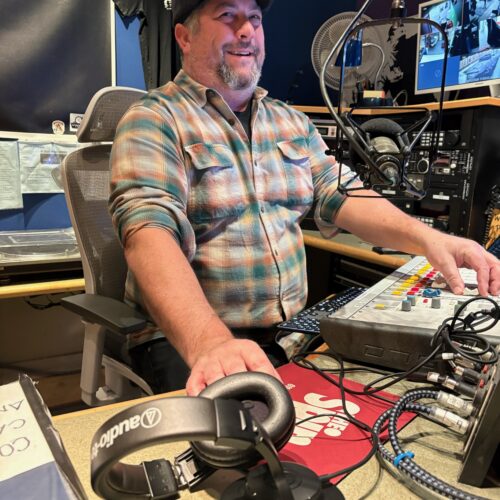
Meet this month’s DJ –Jedediah Bracy, Point of Departure, Mondays 5 – 8pm
Let’s start with the most important thing, Jed or Jedidiah?
Ha! For the radio, I go by Jedediah. Socially, I always go with Jed because it’s much easier to say. It’s a little more of a mouthful to say Jedidiah, but on air, I say it, but you can call me Jed.
Tell me first about your show. How would you describe it to somebody who’s never heard it before?
That’s a good question. I always find that one a challenge to answer. It’s called Point of Departure and is inspired by the name of an Andrew Hill album on Blue Note Records. Hill was a jazz pianist who really made his mark in the 60s. .
The phrase Point of Departure always stuck out to me, just as kind of like a launching point, a trajectory. And so for me, I have a pretty eclectic taste in music. I have a very large record and CD collection, and I love the kind of evolution and cross pollination that we see in music, the cultures and the international aspects and the history. So my show tries to reflect that.
I usually ground it to the day. So, for example, maybe this day in history, an obscure artist was born, or somebody famous recently passed away. Other than that, I think I just love music new and old, so I might have a song in there from the early ‘30s that might have some interesting lyrics or instrumentation to it, but I play lots of new music as well, and everything in between. So it’s hard to capture exactly what Point of Departure does, but hopefully it reflects the eclectic kind of idea I have about music.
And when you say there’s this cross pollination that occurs between different genres, different artists and things, do you talk about that on your show, or do you let the music stand alone and hope people catch it?
I think there’s a balance in between both. I definitely like to explain certain things but will also juxtapose songs, just to let them speak for themselves.
Do you think that your audience will follow along with what you’re not saying? And do you care whether they pick up on this cross pollinating that you’re exposing them to?
Maybe on some level,I think the trajectory of a show is meant to kind of reflect the hour, so there might be a little more energy in the five o’clock hour. I’m on from 5 to 8pm, and that first hour is kind of the drive-time commute. That tends to be the time when I’ll play new music, maybe something with a little more energy, a little louder. And then as we get closer to dinner time into 8pm there’s some peaks and valleys, some mellowness.
I try to have a little bit of rhythm to the show. Hopefully, at least on a subconscious level, the listeners will kind of pick up on some of the things I’m doing. I don’t want to over-explain things. I think the music can certainly speak for itself.
So I get that. I think even if they don’t pick up on the particular idea that you’re trying to throw out there, it makes for good radio, because this song segues into this one nicely, because there’s some reference from song to song.
.Sure. I think about when I first started DJing, I would plan out the whole show and have exactly what I wanted to play arranged. Now, I certainly have an idea of what I want to play but there’s a bit of improvisation that I’ll do in there as well, just as we go. There’s a feel to it.
That’s impressive, because I still do what you were doing before. I plot this thing out to the nth degree.
Yeah. I’ll sometimes change direction and throw something in there and be like, maybe I shouldn’t have done that, but I’ll try and use the cue as much as possible. I’m constantly listening ahead to what I’m going to play next, so I have a little bit of an idea of what the energy of the next song is.
I found when I tried to lay out the entire show – start-to-finish – when I made a mistake live, I would feel more pressure. With improvisation, it takes a little bit of that pressure off. I do a three-hour show but could easily do four hours.
Music is just such a big part of my life. And I’m lucky, I have some really good friends who are also into music. We’re always talking about it and going to concerts.
Plus we live in a great area. The Seacoast is a fantastic place. Everything from the Button Factory Stage here with local music to the Press Room, 3S Artspace, Jimmy’s, all the way to Portland and Boston. We’re just in a really great area. We’re fortunate to have all these fantastic local musicians and community, so I’m always grateful for that.
Let’s talk about this Seacoast area for music. Who have you caught lately?
Locally, I’m a big fan of Guy Capecelatro III. He just released a Christmas album, back in December. There’s a whole local scene from the Soggy Po’ Boys to Marty England, Jon McCormick, Djim Reynolds, Laura Fox, Stu Dias, Eric Fernald, Rick Habib (a co-worker), too many to name here. The Seacoast is flowing with local talent.
I’m also a big fan of Diaspora Radio. This is a loose collective of musicians who cover a different album every month. For January, they covered David Bowie’s album “Black Star,” which is an album that has a lot of meaning for me. Before I started my show in 2016, “Black Star” came out, and I was a huge David Bowie fan. And of course, two days after the album’s release, he passed away knowing that he had been sick for a year. He didn’t tell anyone. Even the people he made the album with had no idea he was as sick as he was, and he was putting on a play at the same time called “Lazarus.”
I recently discovered a new club down in Medford, Mass. called Deep Cuts. I caught Ryan Davis and the Roadhouse band down there, a fantastic indie country band and just saw the Magic Tuber String Band. It’s a kind of a traditional Appalachian folk group with a psychedelic element to it.
I’ll also be going to the Solid Sound Festival at Mass MoCA this summer. That’s Wilco’s festival. Billy Bragg will play the Mermaid Avenue tapes from the late 90s. Gang of Four is going to be there. The Breeders and a lot of smaller bands. My wife and I have been going to Solid Sound since 2017. It’s every other year, and that’s where we discovered bands like Big Thief, Kevin Morby, Horsegirl and Wednesday and saw late greats like Tom Verlaine of Television..
Let’s talk about WSCA for a bit. How’d you get started here? And when was that?
I started here 10 years ago, in 2016. A good friend, Jay Boucher, was here at the time, and he convinced me to sit in on a couple of his shows to see how it worked. Rick Dirk and Rick Pickford were here at the time. Both Rick’s now have left us, may they both rest in peace. Rick Dirk was a great mentor. Rick was just an amazing person, a really big heart, and I think he really understood what this place was all about, the volunteerism, the culture and the music. He had a great ear for music, too.
So by October of 2016 they approved my show. We’ll celebrate our 10th anniversary this October. I’m very excited for that.
Will you celebrate it on air in a particular way?
That’s a good question. Maybe I’ll play songs that mention the number 10.
Or play your whole set list from your first show.
You know, I recently looked that up! I would say it was a little more experimental than I am now. There’s a lot of electronic in there, a lot of jazz improvisation, all of which I still like now. But I’ve probably tried to make the show a little more accessible than when I first started, because I want people to feel comfortable listening. I want to play music that is sometimes familiar, but I also want to play music that you might not be familiar with and hopefully build a bridge, because for me, at least, music is just good for the soul.
Looking back at the last 10 years, it’s been wild. You know, the world has changed so much in the last decade. Obama was still president when I started. We’ve since entered the Trump era, experienced a global pandemic, see the rise of AI and witnessing all the madness that we’re in right now.
So having this kind of weekly check in, everything from reading the local weather on air to contemplating the state of the world each week as I play this music, has been a healing journey, in a sense. It’s become just part of my circadian rhythm and sense of expression.
I often travel for work, usually over to Europe, and I’m away for a week or two at a time. When I’m away, I miss doing the show and am always excited to come back to do that first one. One perk, because of that travel, is that I go to different cities, buy records and bring that music home. That’s one of the undercurrents in the show, Point of Departure. Usually when I’m in another city – say London – I take a picture of the Tube, or while riding a train, to promote that first show back. It’s kind of like my own point of departure.
Doing this show has definitely been a big part of my heart. 10 years is a decent chunk of my life. I certainly care about the success and the mission of Portsmouth Community Radio. We have so many great people here doing work on their own time without pay, from the DJs to those helping with the live music on the Button Factory Stage and all the work that goes into keeping the lights on here… It’s really impressive. The engineers, the fundraisers … I cannot thank them enough for all the work they do.
I want to talk a little bit about what you do outside of here.
I work for the IAPP. Our mission is to help privacy, AI governance and cybersecurity law professionals do their jobs better through training, certification, knowledge sharing and networking. The profession we serve has rapidly expanded as technology evolved. AI is becoming a major part of the business world and our daily lives. It’s like another paradigm shift equal to or exceeding the rise of the internet 25 years ago.
We are a global company headquartered in Portsmouth, over at Pease Tradeport. We just celebrated our 25th anniversary. The IAPP had humble beginnings and once comprised less than five people working in a small house in York, Me. It has since grown to a large building on Pease with a growing office in Belgium.
I’m the editorial director for the IAPP. I work with a team of writers and editors and cover the latest developments in the digital world. The IAPP puts on conferences around the world and we have a big one coming up in Washington, DC. Prince Harry and Salman Rushdie will each be keynote speakers there, which will be super exciting. I’ve long been a fan of Rushdie’s books.
So you worked your way up in this business. You’ve got these big conferences coming up that you’re doing, and what’s in the future for the company?
Every summer we host an event here in Portsmouth. It’ll be later this June and it’s in conjunction with the Berkman Klein Center at Harvard University. We host it at Jimmy’s Jazz Club and the Music Hall, and bring in world leaders from organizations, governments, the media and academia to talk about privacy, data protection, AI, digital responsibility, things like that.
What other passions do you have?
You know, I’m getting older now so that means I like to play a lot of golf. I love to cook and I love reading. I’m constantly reading, whether it’s about music or fiction, nonfiction. I’m a big history buff.
What are you reading right now?
It’s the first volume in the seven-part series called On The Calculation of Volume by Solvej Balle. She wrote the book years ago. It’s now getting translated into English, but the premise of the book is that the main character keeps waking up on November 18 and cannot figure out why she keeps reliving the same day over and over. It’s her journey trying to figure out how to get out of it. It’s kind of like the literary version of ambient music. It’s a really fascinating thought experiment.
Best compliment you’ve received about your show. Who was it from? What did they say?
Anyone who takes the time to listen, just to let me know, feels so good. I have friends that will text and be like, ‘Hey, you know, cooking dinner, we’re listening to the show, sounds great.” I mean, it doesn’t take much. I have friends and family in different parts of the country. My mom’s down in Florida, my dad’s down in Virginia, my sister’s up in Portland, and they’ll all be listening at the same time and texting me. There’s something really sweet about that.
Growing up, both my parents were big fans of music. My dad went to Woodstock and he and my mom had a record collection, so I knew about bands like the Doors, the Beatles, Dire Straits, Talking Heads and those great bands. And I was lucky enough to get into high school right at the rise of grunge. So Nirvana, Pearl, Jam, Alice in Chains, Soundgarden were all big for me.
Back in the 90s, I also started working at Stroudwater Books in Portsmouth. I worked with Larry Etscovitz, who has a show on WUNH, Classical Connections, and is like an encyclopedia for music. I learned a lot from him. Back then, I really got into jazz. I started listening to John Coltrane, Miles Davis, Charlie Parker. The goods.
The other formative music for me growing up were the Grateful Dead and Phish. I’ve always kind of seen the guys in Phish as like older brothers, you know?
Thoughts about WSCA?
It’s a special place here in the west end of Portsmouth. We have a bunch of great DJs and have this amazing studio with this incredible library of records, and the Button Factory Stage for live music.
I’m grateful to be able to have a weekly show on WSCA and put my voice and musical selections on the air. It’s just such a privilege.
Thanks Jedediah.
Share this: